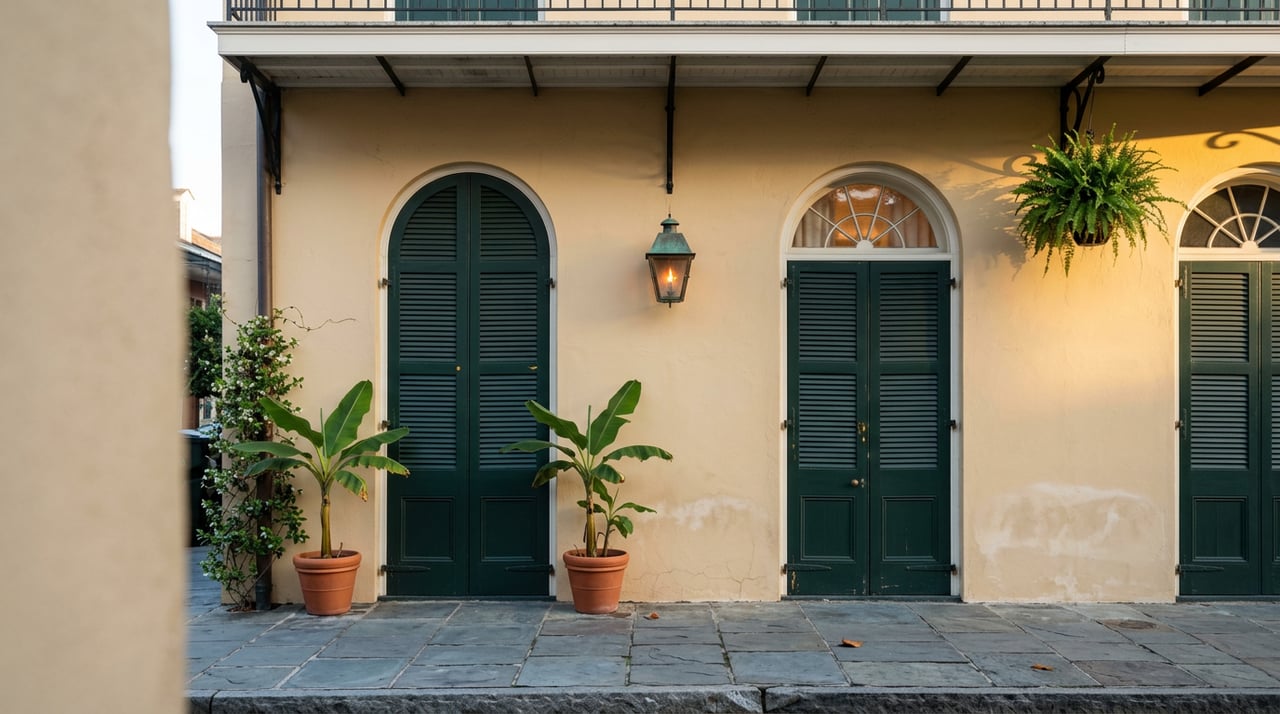
Walk down Dauphine after dinner and something has changed. The blocks below St. Ann used to be the quiet half of the French Quarter, the residential stretch where the tour groups thinned out and the corner grocery kept the same hours it had kept for fifty years. This year, the lower Quarter is where every meaningful opening, reopening, and public investment has landed. If you live here, the map you carry in your head is about to need an update.
The Center Of Gravity Has Moved Downriver
For a decade, the French Quarter's fresh news came from the Canal Street end. New hotels, new restaurants tucked into Iberville and Bienville, adaptive reuse projects hugging the CBD line. This year, the pattern flipped. The single largest civic project in the neighborhood opened at Governor Nicholls Wharf. The grocery that anchors the corner of Dauphine and St. Philip found a new owner with expansion plans next door. Even the year's most talked-about F&B openings sit at addresses that trend downriver rather than up. What follows is a walking tour of the specific changes, in order of how you'd encounter them leaving the Marigny end and heading toward Canal.
Six Acres On Top Of A Working Wharf
The Goldring Woldenberg Riverfront Park opened to the public on April 16, 2026, after a ribbon cutting on April 7. The main entrance from the French Quarter is at St. Philip Street, a two-minute walk from the residential lower Quarter blocks. If you have been trying to figure out why Decatur felt busier than usual this spring, this is why.
A few numbers worth setting against each other. The project took more than a decade of planning and a $30 million investment to produce a 6.3-acre linear park with two lawns, a playground, two landscaped plazas and a covered entertainment area. That works out to roughly $4.7 million per acre, a real number that reflects the fact that the park is built on top of Gov. Nicholls Wharf's concrete deck, with the Mississippi River flowing underneath. Audubon didn't buy land, they engineered a park onto a working piece of port infrastructure. Crews trucked in heaps of dirt to make reinforced lawns that use small fiber strips for festival resilience, released 1,500 worms into the lawns to help with soil health, and planted 120 trees that can tolerate strong winds.
For residents, the practical details matter more than the ribbon cutting. The park is open Sunday through Thursday from 6 a.m. to 10 p.m., which puts it in the same daily rhythm as an early jog or a late walk with the dog. The multi-use path is open for walkers, runners and cyclists, the dog-friendly park has a marsh-themed playground, water misters, swinging benches and shade structures, plus a grove where poles are installed for users to hang their own hammocks, and an obelisk lights up at night to match the Crescent City Connection bridge. One thing that will matter on a summer Saturday: there are no public restrooms in the park, though restrooms are available inside the Aquarium and Insectarium lobby.
The bigger point is the connection. The 2.25-mile path connects Spanish Plaza to Crescent Park, which means residents in the lower Quarter can now walk continuously along the river from their block all the way through the Marigny without stepping onto Decatur or Chartres. That is a structural change to how the neighborhood moves, not a lifestyle amenity.
The Corner Store Is Still The Corner Store
Two blocks inland from the new park entrance, another shift is quieter but arguably more important for daily life. Matassa's Market at 1001 Dauphine, which has anchored the corner of Dauphine and St. Philip since Giovanni "John" Matassa opened the doors in 1924 to serve the Italian immigrant families who dominated the lower Quarter, has changed hands again.
Zahran Bazzar officially took over on Dec. 4, 2025. Bazzar, who previously developed Big Easy Fresh Markets, is back in the grocery business with the purchase of Matassa's, and he is also opening a second branch of his Lebanon Grill restaurant in the French Quarter. He is purchasing both the historic building and the market business, and his stated vision is not to reinvent Matassa's but to restore it as a fully stocked grocery with an upgraded selection that meets the needs of actual residents as well as visitors.
The wrinkle worth watching is next door.
Current owner Zahran Bazaar is seeking to change the zoning for the adjacent property at 1007 Dauphine St. to permit a standard restaurant. Bazaar also owns the nearby Lebanon Grill, and he recently told What Now New Orleans that the sit-down Matassa's restaurant will offer similar Mediterranean flavors. The core of the Matassa's menu will be wood-fired pizzas.
Bazaar is currently in a compulsory neighborhood participation program that seeks feedback from surrounding residents and businesses, and partly based on that feedback the city will decide on a zoning change for a restaurant in the historic district. If you live within a few blocks of 1007 Dauphine, this is the kind of proposal where your comment actually enters the record. Historic district zoning approvals are one of the very few municipal processes in New Orleans that weight resident feedback heavily.
Two Restaurants The Upper Quarter Is Getting
None of this is to say the Bourbon-and-Canal end of the neighborhood is standing still. Two of the most watched restaurant projects of the year are landing on the upper Quarter's edge, and they are both worth walking to.
Holywater opened on Conti this summer. Crew, a New York-based restaurant group led by Alex and Miles Pincus, launched Holywater at 622 Conti Street in the historic, three-store building briefly home to Salon by Sucre, and beloved local chef Alex Harrell, formerly of Angeline, Elysian Bar, and the Gloriette, was tapped to lead the kitchen. The menu is seafood-forward. It features lots of seafood specialties from charbroiled lobster frites and a fruit de mer tower to a ton of oysters sourced from all of our country's coasts.
The second project is a reboot of a Quarter institution that closed last summer. The Champagne bar Effervescence closed in August, but the chefs who ran its kitchen from the start are developing a new upscale seafood restaurant in its place, Brenna Sanders and Evan Ingram, a married couple who worked at Michelin-star restaurants in San Francisco and at Restaurant August locally before helping open Effervescence in 2017. The concept is more specific than the space it replaces. The Crustacean Club will focus on elevated treatment Gulf seafood in particular plus caviar from other waters, and in addition to the regular menu it will have a private dining room for about 20 people where the chefs will serve special tasting menus. Though initially targeting an opening in 2025, the restaurant is now aiming for October.
Notice the difference in scale. The upper Quarter is getting two individual restaurants, both promising. The lower Quarter is getting a public park, a revived century-old grocery, and a proposed pizza restaurant, all clustered within a five-minute walk of each other. That is a neighborhood pattern, not a coincidence.
What Phase Two Would Actually Mean
If you want to know where the pattern is heading, look at what Audubon has said about the next stage of the riverfront project. Audubon has begun visualizing phase two, which would redevelop the Esplanade Avenue Wharf by the end of 2030, and while phase one is designed as a civic park, phase two is envisioned as the entertainment district. Audubon wants to layer the revenues there to make the park economically sustainable, it could look like South Market with a space packed with restaurants, bars and shops, and Audubon is talking with developers already.
For anyone who owns or rents in the lower Quarter, this is the piece of news that matters most for the next four years. Esplanade Avenue Wharf sits directly behind the residential heart of the neighborhood. A South Market-style development there is a different kind of neighbor than a working wharf. The second phase of the project, which will redevelop the Esplanade Avenue Wharf, is scheduled to begin later this year, so the construction fencing that has quietly defined the river edge for the last two years is going to move, not disappear. Public meetings will come next to get input. Show up to those if you have opinions about what the block behind your block should look like at night.
The Short Walk That Explains The Year
Here is the walk. Start at the St. Philip Street entrance to Goldring Woldenberg Riverfront Park in the early evening. Loop through the marsh playground and the Front Porch, then exit back onto St. Philip and walk two blocks inland to Dauphine. Matassa's is on the corner. Pick up whatever you need for the next morning. Walk another eight blocks upriver on Dauphine and cut over to Conti to see the Holywater room from the sidewalk. By the time you get back to Bourbon, you will have crossed every important thing the French Quarter added in 2026.
The neighborhood you knew is still here. It has simply grown a new spine along the river, and that spine runs from Governor Nicholls down toward Esplanade, not up toward Canal. If you have been thinking about your home here as a piece of a long-term plan, that shift is worth folding into your thinking.
If you would like to talk about what these changes mean for your block specifically, whether you are considering a sale, an investment purchase, or simply want an informed second opinion, The Kathryn Collection offers a free consultation grounded in exactly this kind of neighborhood-level detail.